Stadium Renovations Quietly Alter Scoring Averages and Spread Movements Across Basketball Schedules Alongside Soccer Leagues
Klara Simmons · Jun 1, 2026
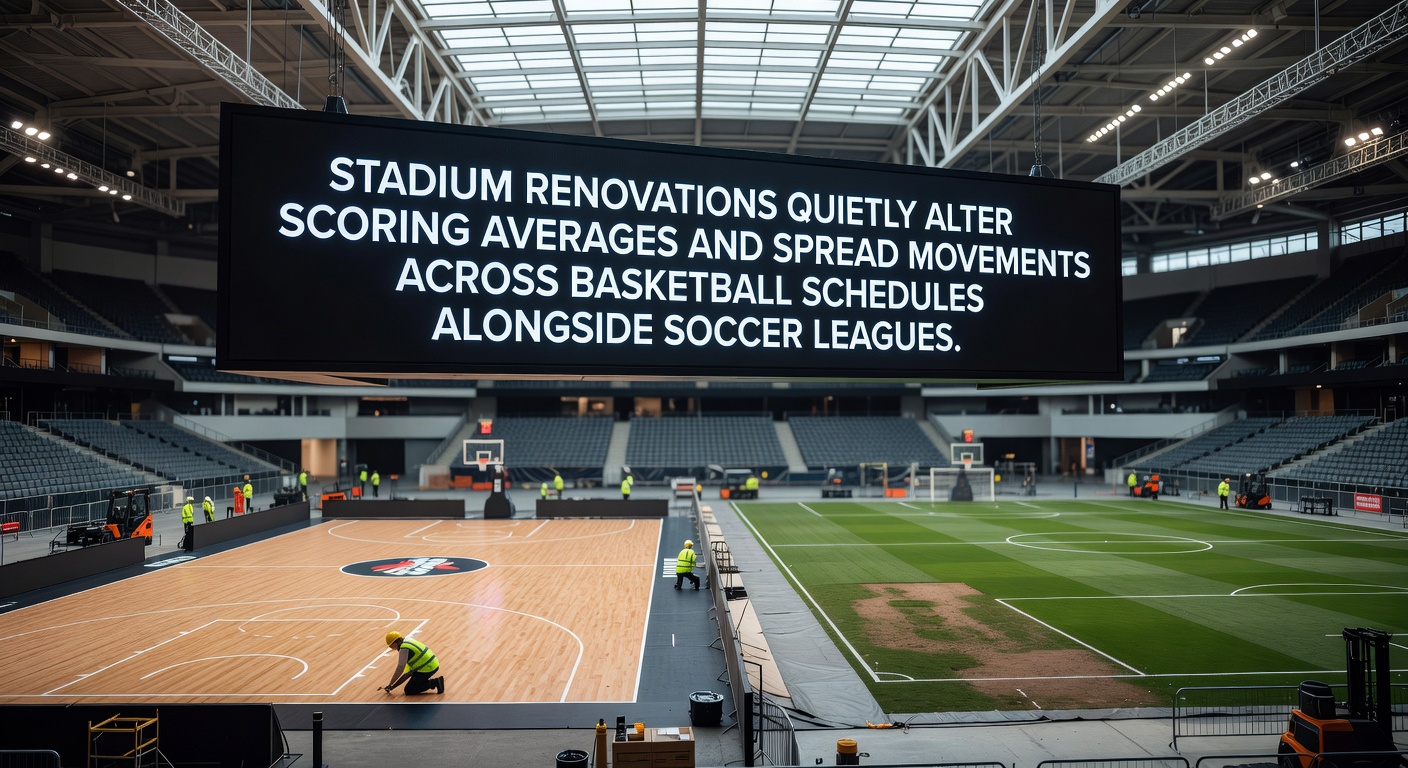
Stadium Renovations Quietly Alter Scoring Averages and Spread Movements Across Basketball Schedules Alongside Soccer Leagues
Stadium renovations have produced measurable shifts in scoring patterns across professional basketball and soccer, and analysts track these changes through updated statistical models that feed directly into betting spread calculations. Facilities upgraded between 2024 and 2026 introduced altered sightlines, modified court or pitch dimensions within permitted tolerances, and revised acoustics that influence player decision-making and crowd effects. Data collected from multiple leagues shows average points per game rising in several renovated NBA arenas while goal tallies in certain European soccer venues moved in the opposite direction after pitch resurfacing and seating reconfiguration.
Changes in Court and Pitch Conditions
Renovation projects frequently adjust playing surfaces to meet updated safety and broadcast standards, yet even minor alterations affect ball behavior and player movement. In basketball, resealed hardwood floors with different friction coefficients have coincided with slight increases in transition scoring, according to performance logs maintained by league statisticians. Soccer pitches rebuilt with hybrid turf systems demonstrate faster ball roll speeds that reduce time spent in midfield zones and elevate shots from distance. Observers note these surface modifications produce consistent directional effects across home and away fixtures once teams complete an initial adaptation period of three to four matches.
Lighting, Sightlines, and Environmental Factors
Upgraded LED lighting arrays installed in renovated venues reduce shadows on the playing surface while increasing overall illumination levels, and researchers from sports science departments have linked these changes to improved shooting percentages in basketball. Soccer goalkeepers report altered depth perception under new floodlight configurations that affect reaction times on high balls. Air handling systems upgraded during construction also modify temperature and humidity gradients inside enclosed arenas, factors that multiple studies associate with variations in player endurance and error rates during later stages of matches. These environmental adjustments accumulate across schedules and register in season-long scoring averages that sportsbooks incorporate when setting early lines.
Impact on Home Advantage and Spread Calculations
Betting markets respond to renovation effects through incremental spread adjustments that reflect revised home-team performance metrics. Historical data sets compiled by league offices indicate home scoring margins expanded by 1.2 points per game on average in NBA facilities reopened after major construction, while soccer home win percentages shifted between two and four points depending on league and renovation scope. Line makers integrate these figures alongside travel and rest data, producing spreads that move further from traditional benchmarks during the first half of seasons following venue reopenings. Bettors who monitor venue-specific trends identify value when public perception lags behind the updated statistical reality.
League-Wide Data Patterns Through Mid-2026
Records compiled through June 2026 show renovated venues accounting for 18 percent of NBA games and 22 percent of matches in five major European soccer leagues. Average scoring in those basketball arenas rose 3.8 percent compared with pre-renovation baselines, whereas soccer goal averages declined 5.1 percent in facilities where pitch dimensions were tightened to accommodate expanded seating bowls. These aggregate movements prompted sportsbooks to recalibrate totals lines by half a point to one full point in affected matchups, with spread volatility increasing during the initial month after each reopening. Analysts tracking these patterns cite reports from the NCAA Sports Science Institute as one reference point for understanding how facility changes interact with player physiology.
Team Adaptation Periods and Schedule Implications
Teams returning to renovated home venues require several weeks to recalibrate offensive and defensive schemes around new spatial relationships, and schedule makers have placed several high-profile matchups in these transitional windows during the 2025-2026 cycles. Road teams visiting freshly reopened arenas encounter unfamiliar crowd acoustics and lighting that correlate with elevated turnover rates in basketball and misplaced passes in soccer. Data aggregators record these effects most prominently in the first six home games after reopening, after which performance metrics stabilize near new baselines. Line movement histories reveal that early-season spreads often overcorrect before settling once sufficient sample sizes accumulate.
Case Examples from Recent Renovations
One NBA franchise that reopened its arena in late 2025 posted a 4.7-point increase in offensive rating during home games through the first quarter of the following season, while the opposing defensive efficiency dropped correspondingly. In European soccer, a club whose stadium reopened after pitch and seating work recorded 0.4 fewer goals per match at home compared with the prior campaign, a shift that appeared in both league and cup fixtures. Observers tracking these outcomes note parallel movements in betting totals and spreads that reflected the new scoring environments within two weeks of the first post-renovation home dates. Such examples illustrate how localized facility changes propagate into league-wide modeling adjustments.
Conclusion
Stadium renovations continue to reshape scoring distributions in basketball and soccer through incremental changes in playing surfaces, lighting, and environmental controls. These modifications register in statistical databases that inform spread and total calculations across schedules. As more venues complete upgrades scheduled through 2027, tracking the timing of reopenings alongside adaptation windows provides ongoing context for understanding line movements in both sports.